 |
|
|
|
 |
|||
 |
|||
 |
 |
 |
 |
 |
|
||
 |
|
||
 |
|
||
 |
|
||
 |
|
||
 |
|
||
 |
|
||
 |
|
||
 |
|
||
 |
|
||
 |
|
||
|
|
|
|
|
|||
|
|||
|
|
|
|
|
|
||
|
|
||
|
|
||
|
|
||
|
|
||
|
|
||
|
|
||
|
|
||
|
|
||
|
|
||
|
|
||

by Gale Randall
 or our week’s
stay in Tuscany, my friend and I chose the charming Hotel Borgo di Cortefreda
as our base, in Tavarnelle Val di Pesa, a village in Chianti just outside
the city of Florence. From the Borgo we’d take off for day trips into
Florence and surrounding villages, soaking up the bounties of Tuscany, its
art, gorgeous countryside and delightful hill towns and cuisine. Our first
excursion was into the village of Tavarnelle to view the charming Church of
Santa Lucia al Borghetto and its fine frescoes. Then it was off to Volterra,
important since Etruscan times and home to a fascinating Etruscan museum.
We hiked down Volterra’s twisting medieval streets to the museum, admiring
its ancient statuary, sarcophagi and ruins, and stopping at a gelateria en
route back to our bus.
or our week’s
stay in Tuscany, my friend and I chose the charming Hotel Borgo di Cortefreda
as our base, in Tavarnelle Val di Pesa, a village in Chianti just outside
the city of Florence. From the Borgo we’d take off for day trips into
Florence and surrounding villages, soaking up the bounties of Tuscany, its
art, gorgeous countryside and delightful hill towns and cuisine. Our first
excursion was into the village of Tavarnelle to view the charming Church of
Santa Lucia al Borghetto and its fine frescoes. Then it was off to Volterra,
important since Etruscan times and home to a fascinating Etruscan museum.
We hiked down Volterra’s twisting medieval streets to the museum, admiring
its ancient statuary, sarcophagi and ruins, and stopping at a gelateria en
route back to our bus.
We
hiked down Volterra’s twisting medieval streets …
My favorite Tuscan hill towns were San Gimignano and Lucca, San Gimignano
for its many unusual tower buildings, some of which are still inhabited, and
Lucca for its lovely piazzas. Popular pastimes in Lucca —birthplace of
the composer Puccini, are renting a bike to traverse the city streets and
alleys, and hiking its famous walls and ramparts. At a Lucca café we
chatted with a group of Dutch students who were quite intrigued by our forthcoming
American presidential election.
We spent two days exploring Florence. The cradle of the Italian Renaissance, Florence is almost overwhelming in the abundance of its art. Having seen Michelangelo’s David on a previous visit, I chose to skip the Accademia this time in favor of spending more time in the Uffizi Gallery and Pitti Palace. In the Uffizi we almost missed seeing the famous Botticellis and had to backtrack to their gallery. It’s easy to understand why a painting such as The Birth of Venus is so important—art before Botticelli seems heavy-handed and dark in comparison.
After viewing hundreds of paintings, we stopped at the outdoor Uffizi café,
a pleasant spot with views of the famous Duomo church and Florentine skyline—in
addition to serving terrific gelato. The following day we returned to the
city to explore the Pitti Palace, which is across the River Arno from the
Uffizi. The Pitti Palace was begun in 1458 by the Pitti banking family but
later sold to the rival Medicis after the Pittis went bankrupt. It was easy
to imagine the Medici conducting their intrigues and affairs and sponsoring
artists in this enormous meandering edifice. The Pitti, which overlooks the
Boboli gardens, contains some rooms with period furniture, in addition to
much of the Medici private art collection. After leaving the Pitti, we splurged
on leather goods in a shop on Via Vacchereccia,
Siena, home to the famous Palio horse races in July and August, was our last
Tuscan hill town. I particularly enjoyed visiting the Duomo as its green and
white patterned marblework reminded me of the famous mosque of Cordoba, Spain.
Though no horse race was in progress at the time, it wasn’t hard to imagine
such an event taking place in the Campo, Sienna’s pretty piazza, where
we relaxed at a café.
Food at the Borgo hotel and in all the cafés of Tuscany was quite
tasty, particularly the pastas, hearty soups, and of course the gelato. Tuscany
is a region that invites revisiting. If given the opportunity, I surely would.
Hotel Borgo di Cortefreda: www.borgodicortefreda.com.
Uffizi Gallery and Pitti Palace: www.florence-museum.com.
Gale
Randall is a freelance travel writer based in Palo Alto, California.
Return to: Current articles, Top, Home.
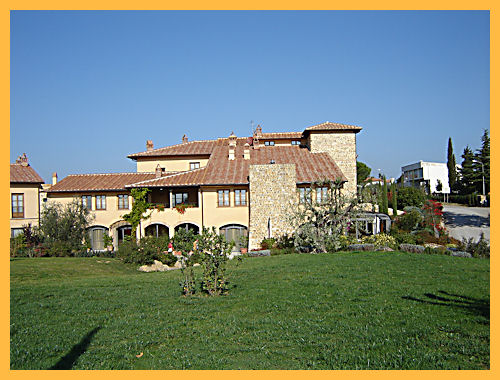
The
Hotel Borgo di Cortefreda
Gale Randall photo
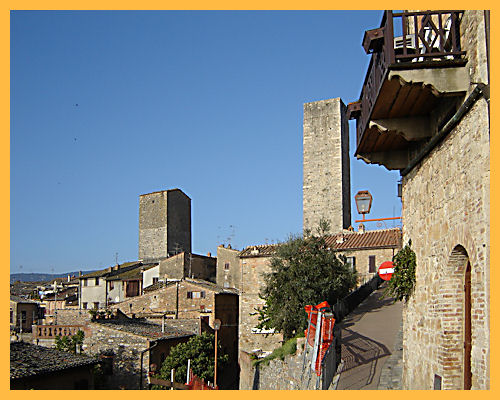 San
Gimignano
San
Gimignano
Gale Randall photo