 |
|
|
|
 |
|||
 |
|||
 |
 |
 |
 |
 |
|
||
 |
|
||
 |
|
||
 |
|
||
 |
|
||
 |
|
||
 |
|
||
 |
|
||
 |
|
||
 |
|
||
 |
|
||
|
|
|
|
|
|||
|
|||
|
|
|
|
|
|
||
|
|
||
|
|
||
|
|
||
|
|
||
|
|
||
|
|
||
|
|
||
|
|
||
|
|
||
|
|
||

by Monica Conrady
 he Canary Islands is not a destination one hears too much about
in this country, although it has long been a popular spot for sun-starved
British and German tourists. Frankly, it didn’t sound too appealing to
me — I had visions of wall-to-wall holiday villas and not much else.
So when my husband, Ray, was offered a month-long job in Tenerife, the largest
and best-known island, I decided to join him. I wanted to see if there actually
was a “there” there.
he Canary Islands is not a destination one hears too much about
in this country, although it has long been a popular spot for sun-starved
British and German tourists. Frankly, it didn’t sound too appealing to
me — I had visions of wall-to-wall holiday villas and not much else.
So when my husband, Ray, was offered a month-long job in Tenerife, the largest
and best-known island, I decided to join him. I wanted to see if there actually
was a “there” there.
I
wanted to see if there actually was a “there” there.
Although the Canaries are a part of Spain, this seven-island archipelago
is really closer to the coast of Africa than to mainland Spain. While there,
visitors sometimes make the mistake of referring to Spain as another country.
Not so — they are in Spain! The islanders themselves refer to mainland
Spain as “the Peninsula.”
His job completed, my husband, booked us into a hotel on the Plaza España
in Santa Cruz, Tenerife’s capital. Arriving at the Hotel Plaza after
my long flight from San Francisco was a real treat, and after a good night’s
sleep and a tasty breakfast, we were ready to go exploring. Most of the sights
are within walking distance of the Plaza España. Nearby, dominating
the waterfront, the Auditorio de Tenerife is a stunning modern structure reminiscent
of the Sydney Opera House, with a roof shaped like a soaring wave about to
break. Designed by Spanish architect Santiago Calatrava, it’s a world-class
venue for concerts and the arts.
Tenerife’s island-wide bus transport system is so good there was really
no need to rent a car, so after a short stay in Santa Cruz we caught a bus
to Puerto de la Cruz, an attractive though touristy resort town about an hour’s
ride away on the other side of the island.
From there we went on to the tiny town of Los Silos where a Fiesta in honor
of their patron saint, San Antonio Abad, was taking place. The highlight was
the Blessing of the Animals. Farmers with their livestock, locals with their
various pets, walked in procession down the main street past the parish church
to be blessed by the priest. Cattle, goats, sheep, dogs, cats, ferrets, tortoises
— you name it — ambled by, much to the delight of onlookers.
We spent the night in the newly opened Hotel Luz del Mar — the only
place in town we could find to stay. We loved it, and wished we could stay
longer.
Our next stop was Garachico, one of the most historic towns in the Islands.
Centuries ago, it was Tenerife’s main trading port, but a series of disasters
— floods, fires, epidemics and finally a major volcanic eruption in 1706
— put an end to its golden age. Today it is a charming town with a very
Spanish feel. At the center is the Plaza Libertad, where children play, couples
promenade and at dusk people gather at the outdoor cafés for an aperitif.
We stayed in a private home just off the plaza. Getting to know a local family
was a delightful experience.
From Garachico, we booked a day tour to El Tiede, an active volcano and Spain’s
highest peak. It’s a dramatic lunar landscape with strange and wonderful
rock formations. We stopped in La Orotava on the way, a lovely colonial town
that has it all — cobbled streets, white-washed houses, and flower-filled
plazas.
The trick to visiting Masca, a stunning mountain village reached by impossibly
winding roads, is to get there before the tour buses arrive — then you
can really appreciate its beauty. We did this, and enjoyed our morning café
con leche in peace at a restaurant perched on a cliff overlooking the valley
below.
Finally, we headed back to Santa Cruz by continuing by bus around the entire island. We had thought we would visit some of the other islands, but Tenerife proved to have so much to see and do that we ran out of time. And I found that yes, there is definitely a “there” there.
Canary Islands: www.canaryislandstouristguide.com
Return to: Current articles, Top, Home.
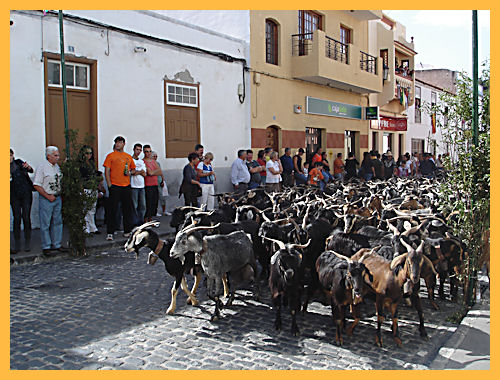
Rush
Hour in Los Silos
Monica Conrady photo
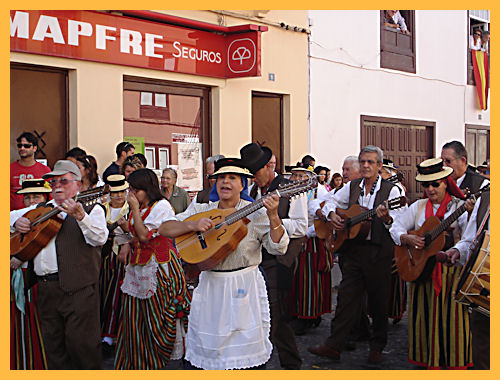 Fiesta
of San Antonio Abad
Fiesta
of San Antonio Abad
Monica Conrady photo